
China Gantry Barrel Zinc Plating Equipment for Superior Corrosion Protection
2026-08-26
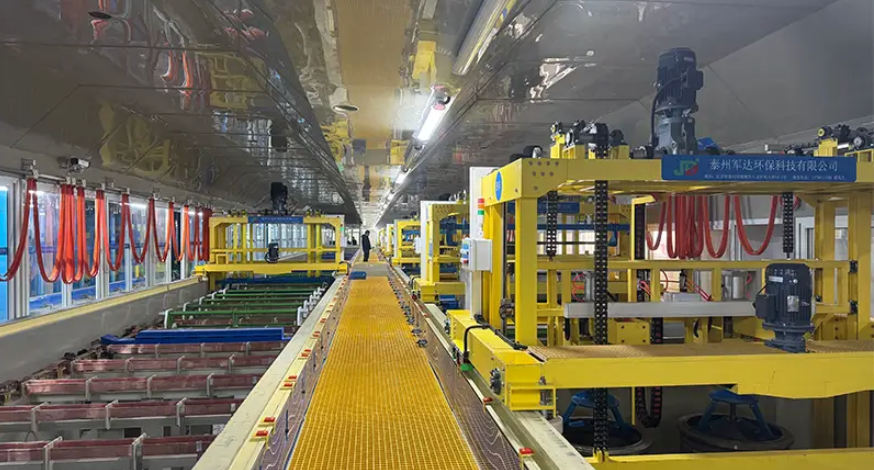
Ask any plating shop manager about their biggest headache, and corrosion-related rejects usually top the list. The fix often isn't a thicker zinc layer—it's a smarter gantry barrel plating system. In China, Junda has been quietly rewriting the rules for how these lines handle barrels, current distribution, and rinse efficiency, all in the name of superior corrosion protection. Before you spec your next line, here's what makes a gantry barrel setup genuinely stand out.
How Gantry Automation Redefines Barrel Zinc Plating Workflows
In most barrel zinc plating lines, the transfer sequence still depends on a hoist operator’s timing and a chain of manual checks. Gantry automation strips that layer of guesswork out of the process. Instead of a fixed pause at each station, the gantry reads the actual barrel position, adjusts pick-up angles on the fly, and moves the load through degreasing, pickling, plating, and post-treatment with far less idle time between tanks.
The real shift shows up in plating thickness control. A gantry can hold the barrel under current for an exact, recipe-driven cycle while rotating it at a consistent speed, so the deposit builds more evenly across recessed parts. Operators no longer need to compensate for human delay or inconsistent manual travel speeds; the line runs the same way on a night shift as it does at noon.
Maintenance and changeover also become less reactive. Because the gantry logs every movement and bath entry, it is easier to spot a station that repeatedly triggers alarms or a load that takes longer to drain. That data feeds back into simple workflow adjustments—shortening transfer paths, grouping similar part numbers, or fine-tuning dwell times—without rewriting the entire line.
Corrosion Resistance Secrets: Zinc Layer Uniformity Explained
Zinc coatings rarely fail uniformly across a surface. The thinnest spots become the weak link long before the average thickness drops below critical levels. At a scratch or an edge where the zinc layer is just a few microns thinner, the underlying steel is exposed sooner, and the galvanic protection shifts from broad-area sacrifice to concentrated attack. This is why two parts with identical nominal coating weights can perform very differently in salt spray tests—one may show red rust in 200 hours while the other stays clean past 1,000, simply because the zinc is distributed more evenly.
Uniformity is not just about average thickness; it is about how the coating follows the contours of the base metal. Sharp corners, deep recesses, and threaded areas tend to build up less zinc or, in electroplating, can suffer from current density extremes that leave either porous deposits or brittle, over-thick edges. A well-controlled process adjusts anode placement, bath agitation, and current ramping so that the deposit grows at a similar rate across high- and low-current regions. The result is a zinc layer that behaves like a continuous sacrificial skin rather than a patchy covering with hidden thin zones.
One practical way to assess this is through cross-section microscopy or X-ray fluorescence mapping rather than relying on a single thickness reading. When the coating varies by more than about 20% across critical surfaces, corrosion often initiates in the same predictable areas: cut edges, inside corners, or spots where the part touched a rack during plating. Reworking those areas before assembly can extend service life far more than adding extra zinc to already well-covered faces.
Why Chinese Manufacturing Leads in Heavy-Duty Plating Lines
The dominance of Chinese suppliers in heavy-duty plating lines is built on a rarely discussed advantage: the physical clustering of component makers. Rectifier producers, titanium anode fabricators, tank welders, and automated crane builders often operate within the same industrial zone, so design changes propagate through the supply chain within days rather than weeks. When a buyer needs to extend a zinc-nickel line for extra-long steel beams, the engineering team doesn't wait for third-party quotes; they pull in neighboring specialists, rework the rail span and busbar sizing, and release updated drawings before many overseas competitors have finished their first site survey.
Cost is often mistaken as the main draw, but what actually convinces buyers is the readiness to deviate from catalogue dimensions. Chinese manufacturers routinely reinforce polypropylene tanks with external steel framing, adjust anode-to-cathode distances for unusual geometries, and specify thicker copper busbars for high-current acid copper processes. Because they purchase stainless steel and titanium in volumes tied to multiple concurrent projects, material pricing remains stable even when a single line weighs several hundred tonnes. This blend of deep customization and bulk procurement means heavy-duty systems handle aggressive chemistries and heavy racks without the price premium that usually accompanies non-standard engineering.
Environmental compliance has also shifted from an afterthought to a standard feature. Many plants now integrate closed-loop rinse systems, chromium scrubbers, and sludge dewatering units as part of the base package rather than expensive add-ons. Export-focused workshops are familiar with EU directives and North American electrical codes, so meeting local permits is rarely a stumbling block. The result is a delivery model where a 15-station hard chrome line can be designed, fabricated, and shipped with full documentation in a timeline that few other manufacturing regions can match.
Overlooked Design Details That Boost Plating Consistency
Most platers obsess over bath chemistry and rectifier settings, yet overlook the role of rack contact geometry. A slight variation in how a part hangs can shift local current density enough to produce ghost marks or thin spots. Swapping smooth, polished hooks for ones with a brushed or textured grip does not just improve adhesion; it stabilizes the contact resistance across a full load, which matters more than chasing a few millivolts in the setpoint.
Drainage after rinsing gets far less attention than it should. Parts with blind holes or nested features trap solution, and that leftover film dries into uneven activation zones before the next tank. Adding a tiny weep hole or subtly angling a baffle breaks the surface tension just enough to let gravity do the work. This single change often clears up mysterious patchiness that no amount of filtration or brightener adjustment can fix.
Another detail hiding in plain sight is the spacing between the anodes and the tank wall. When the gap is too tight, flow becomes restricted and the anode dissolves unevenly, which then throws off the metal distribution on the parts. Widening that gap by as little as a few percent can smooth out the current path and reduce the need for aggressive air agitation, which itself disturbs the boundary layer at the part surface.
Scaling Production Without Sacrificing Coating Quality
Ramping up output typically exposes every hidden weakness in a coating process. The first place to look is not the spray gun or the oven, but the fluid delivery system. When line speed increases, viscosity drift, temperature swings, and inconsistent atomization become magnified. A common fix is to move from manual mixing to inline blending with real-time viscosity control. This keeps the coating within its application window even as throughput climbs, eliminating the need to slow down for adjustments.
Another overlooked factor is the cure profile. Faster production often tempts operators to shorten dwell times or raise oven temperatures, but that can leave the coating under-cured at the interface or over-baked at the surface. Instead of pushing the thermal limits, consider staging the cure with a lower initial ramp followed by a sustained hold. This allows the coating to cross-link evenly across thicker parts and complex geometries, so you gain throughput without sacrificing adhesion or chemical resistance.
Finally, tracking quality at higher speeds demands a shift from post-process inspection to in-line monitoring. Simple film thickness gauges and gloss meters can catch drift before a full batch is ruined. Pairing these with automated feedback loops on spray parameters keeps the coating within spec even when raw material batches vary. Scaling production then becomes a matter of tightening control loops, not accepting more scrap.
The Real Cost of Inferior Zinc Plating Equipment
When a plating line goes down because a rectifier overheats or a barrel drive strips its gears, the immediate invoice for a replacement part is just the tip of the iceberg. Every hour of unplanned downtime means idle labor, missed shipment deadlines, and often expedited freight charges to keep customers from walking away. Cheap zinc plating equipment tends to nickel-and-dime you with frequent small failures that never justify a full capital replacement but steadily bleed your maintenance budget dry.
Beyond the visible repair bills, inferior equipment quietly inflates your operating costs. Poor current distribution forces you to run longer cycle times or use higher chemical concentrations just to hit minimum thickness specs. Rectifiers with unstable output create uneven deposits, driving up zinc consumption and sludge generation in the bath. Over a year, those extra pounds of anode material and wasted brightener add up to a figure that would have covered a significant portion of a better-quality line.
The most painful cost often shows up weeks later, when a customer rejects a batch for premature corrosion or poor adhesion. Reworking parts, paying scrap value for plated components, and explaining quality escapes to your biggest accounts damages more than your P&L—it erodes the trust that took years to build. Inferior zinc plating equipment doesn't just cost you money today; it quietly caps your ability to take on higher-margin work that demands tight tolerances and consistent finish.
FAQ
These systems are built around high-throughput barrel plating with a gantry layout that moves barrels between tanks automatically. The zinc layer they deposit is uniform, and when paired with the right passivation, it can handle salt spray tests well beyond standard requirements.
Instead of operators moving barrels by hand, the gantry picks up and transfers entire barrel loads on a programmed schedule. That cuts down on human error, keeps dwell times consistent, and allows one person to oversee a line that would otherwise need several workers.
Fastener makers, automotive parts suppliers, construction hardware producers, and electrical component manufacturers are common users. Anywhere small metal parts need dependable rust resistance without rack plating's higher labor cost.
With proper pretreatment and a trivalent or hexavalent passivation layer, parts can often withstand 200 to 500 hours of neutral salt spray before white rust appears. The exact number depends on coating thickness and post-treatment.
Yes, but it works best when parts are sorted by size and weight to avoid tangling or uneven coverage. Perforated barrels with different hole sizes can be swapped in to handle small fasteners or larger stampings.
Regular checks on the gantry rails, barrel drive motors, and plating solution chemistry. Anodes need cleaning or replacement, and filters should be changed based on bath usage. Most suppliers recommend a weekly inspection of electrical contacts and hoist cables.
Lines can be designed with a certain number of barrels, tank sizes, and gantry speed. A small shop might run two barrels per hour, while a high-volume plant could push over a dozen, depending on load capacity and plating time.
Many modern setups integrate dosing pumps for brighteners, pH adjusters, and passivation chemicals. This keeps bath parameters stable and reduces the need for manual titration throughout the shift.
Conclusion
Gantry systems have quietly reshaped how barrel zinc plating lines move parts through each stage, replacing manual transfer with repeatable lift-and-shift sequences that cut cycle time without adding stress to fragile components. The real payoff shows up in layer consistency: instead of relying on operator judgment, the automated travel speed and dwell timing hold every barrel in the bath for the same exposure, so coating thickness stays even across high-volume batches. Small design choices matter just as much—things like barrel perforation patterns, contact bar alignment, and drainage angles often separate a line that plates reliably from one that fights itself shift after shift.
Chinese manufacturers have earned their place in heavy-duty plating lines by pairing thick-gauge steel frames with modular rectifier and tank layouts that survive years of acidic baths and constant motion. Scaling up does not mean loosening quality controls; the better lines use independent current control per station and real-time monitoring of zinc concentration, which keeps coating performance stable when throughput rises. The alternative is costly in ways that show up later: thinner frames warp, rectifiers drift, and uneven plating leads to early rust on customer parts. Buying equipment that barely meets the spec often means paying for rework, returns, and lost trust long after the initial invoice is forgotten.
Contact Us
Contact Person: hayyr
Email: [email protected]
Tel/WhatsApp: 8613082110525
Website: https://www.jundaelectroplating.com