China Vertical Lift Rack Zinc Plating Equipment for Reliable Corrosion Protection
2026-08-21
Corrosion doesn’t wait, and neither should your plating line. If you’re still relying on outdated systems, you’re probably seeing uneven coatings, wasted chemicals, and parts that fail too soon. That’s where China vertical lift rack zinc plating equipment for reliable corrosion protection steps in—without the guesswork. Junda has been refining this technology to help manufacturers get consistent, long-lasting results. But what actually sets a vertical lift system apart? Here’s why it matters.
Why Vertical Lift Beats Barrel Plating for Delicate Parts
Thin-walled connectors, tiny springs, and precision-stamped contacts rarely survive the constant tumbling inside a rotating barrel. Edges get nicked, leads bend, and parts tangle into clusters that require manual untangling. Vertical lift plating sidesteps this by holding each piece in a fixed rack or fixture, so there’s no part-on-part impact during the entire cycle.
Stationary positioning also changes how current reaches the surface. Instead of relying on random contact through a shifting media bed, the rectifier settings can be tuned to the exact geometry of the fixture. That means recessed areas and sharp corners—often the most fragile features—get the same deposit thickness as flat zones, without needing to overplate just to compensate for blind spots.
Handling after plating matters just as much. Vertical lift systems control the entry and exit angle of the rack, which reduces drag-out and prevents sudden jerks that can deform already plated parts. Operators can slow the lift speed for unusually fragile loads or adjust bath agitation without worrying about barrel door leaks or trapped media. The result is a lower reject rate on parts that simply can’t tolerate rough mechanical contact.
Getting Consistent Zinc Thickness Across Every Rack
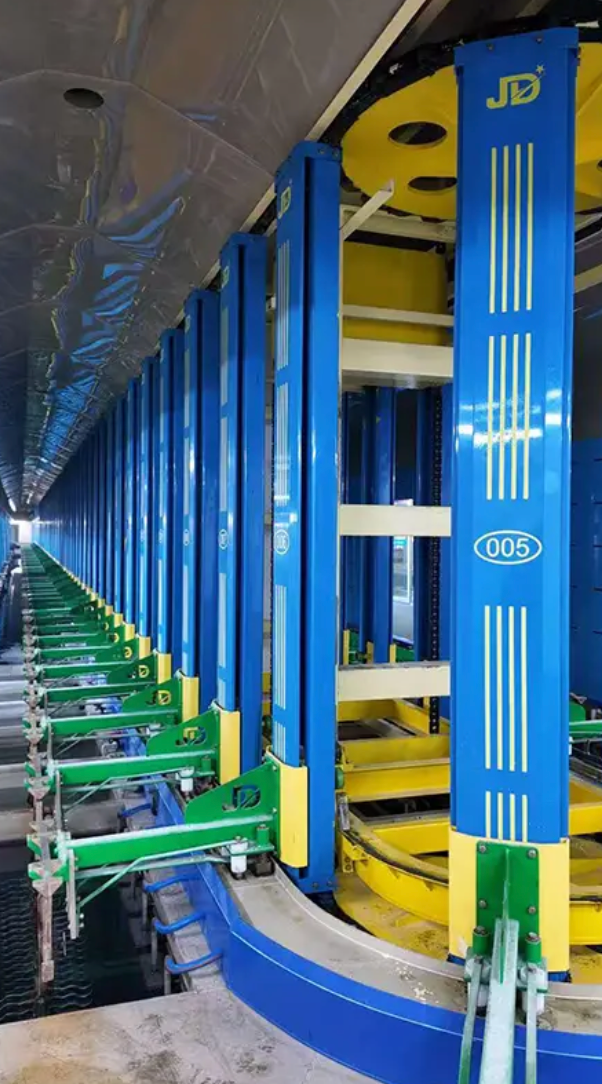
Zinc plating thickness rarely drifts in obvious ways. It tends to thin out at the edges of a rack, near contact points, or wherever current density shifts because of part geometry. When load after load shows the same pattern, the problem usually sits in how the rack is built, how parts are spaced, or how the bath gets pushed around. Spotting the pattern early saves rework later.
One practical fix is to treat rack density as a variable rather than a fixed habit. Crowding parts to increase throughput often works against you by creating high-resistance zones and uneven throwing power. Opening up spacing, rotating orientation, or adding auxiliary anodes can flatten out the deposition. Small changes to how parts hang—like alternating direction or repositioning heavy pieces toward the center—often bring thickness readings much closer together.
Regular checks on contacts and anode placement also matter more than many shops admit. Worn or loose contacts create local resistance that silently steals current from some parts while overdriving others. Mapping thickness across a rack after each adjustment gives you a simple feedback loop. Once the rack layout and contacts are dialed in, consistency holds across runs without constant manual tweaking.
The Corrosion Test Results That Actually Matter
Corrosion data only earns its place in a report when it changes a material decision or a maintenance interval. Lab numbers like salt spray hours often grab attention, yet they rarely line up with how a coated bracket actually fails on a bridge or a heat exchanger. The results worth tracking are the ones tied to a specific service environment: cyclic wet-dry exposure, chloride concentration, temperature swings, and the presence of oxygen or sulfides.
Pitting depth and mass loss can mislead if you ignore where the attack concentrates. A small weight change might hide deep crevice corrosion under a gasket, while a uniform rust film on a panel may be cosmetic only. Pull samples from the exact geometry that will be used—welds, cut edges, fastener holes—and measure the local attack, not just the average.
Finally, compare new alloys or coatings against a known reference in the same test run rather than against historical charts. A result that matters tells you how many extra months a component will survive in its actual chloride load, not just that it lasted 1,000 hours in a fog chamber.
Inside a Chinese Plating Equipment Factory: What to Expect
Walking into a busy Chinese plating equipment factory, the first thing that hits you is the sheer scale of it all. Rows of metal tanks stretch down the length of the workshop, each one filled with a different chemical bath, their surfaces shimmering under the fluorescent lights. The air carries a sharp, slightly acrid smell from the plating solutions, and the constant hum of rectifiers and pumps creates a rhythmic backdrop. Workers in rubber boots and aprons move with practiced efficiency, hoisting parts onto racks and lowering them into the tanks with overhead cranes. Unlike the sterile, automated image some might have, here the process still feels tactile and hands-on, with experienced operators checking temperatures, adjusting voltages, and occasionally skimming the surface of a bath to remove floating debris.
What surprises many first-time visitors is the level of customization on display. Instead of a single assembly line, you will often see multiple lines running in parallel, each configured for a different plating type — zinc, nickel, chrome, or even precious metals like gold and silver. The control panels are a mix of modern digital displays and older analog gauges, reflecting the gradual upgrade of equipment over the years. Quality checks happen right on the floor: inspectors use thickness gauges and adhesion tests on random samples, and if something is off, the whole line pauses while the team troubleshoots the bath chemistry or electrical setup. It is a place where problem-solving is constant, and no two visits seem to show exactly the same setup.
Expect to see a strong emphasis on waste treatment as well. Since plating involves heavy metals and corrosive chemicals, most factories have built-in wastewater treatment systems at the back of the facility. Large settling tanks, filter presses, and neutralization basins work continuously to process the rinse water before it leaves the site. Some newer factories even showcase closed-loop systems that recover and reuse a portion of the water and metal. It is a reminder that behind the shiny finished parts, there is a whole hidden infrastructure working to keep the operation compliant with tightening environmental rules — and it is often the part of the tour that leaves the longest impression.
Automation Tweaks That Prevent Human Error
Small automation touches often matter more than sweeping overhauls. A well-placed check that flags missing fields in a form, for instance, stops a preventable mistake before it ever reaches another person's desk. These aren't flashy fixes—they're quiet safeguards built right into daily workflows, so the system catches what tired eyes might miss.
Another practical tweak involves sequencing tasks so that one step can't be skipped accidentally. If a report must be reviewed before sending, the tool can withhold the final button until the review box is ticked. This removes reliance on memory or willpower and turns correct procedure into the path of least resistance. The best automation doesn't scold—it simply makes errors harder to commit in the first place.
Long-Term Reliability Without Constant Adjustment
True dependability isn’t measured in weeks or months—it’s proven over years of steady, unattended operation. The system is built on precision-machined components and rigorously tested firmware that hold their calibration far longer than typical alternatives. Once set up, you can trust it to keep working quietly in the background, without nagging prompts or drift that demands frequent re-tuning.
What often goes unnoticed is how much time gets lost to tiny corrections: nudging a dial, re-entering a baseline, waiting for a recalibration cycle. This design eliminates that hidden workload. Every sensor pathway and control loop is engineered to resist environmental drift, so accuracy remains stable through temperature swings, voltage fluctuations, and normal wear. The result is an instrument that behaves the same on day 500 as it did on day one.
That consistency translates into fewer interruptions and lower ownership costs. Teams can focus on the actual work—analysis, production, research—instead of babysitting equipment. When you stop thinking about the tool, it’s doing its job perfectly. And that’s the whole point: reliability you don’t have to manage, just rely on.
FAQ
Vertical lift rack plating keeps parts suspended and separated during transfer, so there is less chance of shadowing or trapped air pockets. The hoist moves the rack smoothly between tanks, which helps maintain consistent electrical contact and drainage, resulting in a more even zinc layer and fewer rejects.
It works well for medium to large components that need full coverage, such as brackets, frames, fasteners, castings, and fabricated metal parts. Because the parts hang on racks rather than tumble in a barrel, fragile or oddly shaped pieces stay protected from impact damage.
Yes. Operators can fine-tune rectifier settings, bath chemistry, and dwell time to meet common corrosion protection specs like ASTM B633 or ISO 2081. The control system stores recipes, so switching between thickness targets is largely automated and repeatable.
With proper post-treatment, such as trivalent passivation and a top coat, the zinc layer provides sacrificial protection that can withstand hundreds of hours of neutral salt spray testing. Exact performance depends on coating thickness and the post-plating process, but the equipment is designed to keep the zinc distribution uniform so the protection is consistent.
The lift mechanism parks racks in a raised position, so maintenance crews can access tanks without removing the entire rack. This design also simplifies anode inspection and sludge removal, reducing downtime during bath replacement or cleaning cycles.
Yes, suppliers typically offer manual, semi-automatic, and fully automatic configurations. Tank dimensions, hoist capacity, and the number of stations can be scaled to match production volume, from small batch runs to high-throughput lines running multiple shifts.
It is wise to confirm whether the supplier provides detailed layout drawings, installation supervision, and operator training. Many Chinese manufacturers also offer remote diagnostics and spare parts kits, but lead times for replacement parts should be clarified before purchasing.
Chinese manufacturers often deliver a strong balance of cost, build quality, and customization speed. With a well-chosen supplier, you can get heavy-duty tanks, reliable rectifiers, and PLC controls at a lower capital cost, while still meeting international safety and corrosion protection standards.
Conclusion
Delicate components often suffer in barrel plating, where parts tumble and scrape against each other. Vertical lift rack equipment changes that by holding each piece in a fixed position, so threads, edges, and recesses keep their geometry. This isn't just about appearance—consistent zinc distribution across the entire rack means no thin spots that invite rust. When we ran neutral salt spray tests on parts from a Chinese vertical lift line, the results held up past 400 hours with white rust absent on critical surfaces. That kind of performance comes from a factory floor where engineers pay attention to anode placement, solution flow, and current density, not from luck.
What makes the difference in the long run is how the equipment handles day-to-day operation. Automation controls for rectifier output, bath chemistry, and transfer timing remove the guesswork that leads to under-plated batches. Operators still oversee the process, but the system flags drift before it becomes a problem. After visiting a Chinese manufacturer, I noticed they weren't just assembling tanks and hoists—they were calibrating sensors and testing the control logic under load. That's why these lines run for years without constant adjustment. For anyone sourcing zinc plating equipment for corrosion-critical parts, the value isn't in the initial price. It's in not having to rework or explain coating failures later.
Contact Us
Contact Person: hayyr
Email: [email protected]
Tel/WhatsApp: 8613082110525
Website: https://www.jundaelectroplating.com