OEM AGV Compatible Pallet Supplier Selection: Streamlining Automated Material Handling
2026-06-27
In today's fast-paced manufacturing landscape, automated guided vehicles (AGVs) have become the backbone of efficient material flow. Yet even the most advanced AGV system can stumble when paired with the wrong pallet—misalignment, load instability, and frequent downtime are just the beginning. Finding an OEM AGV-compatible pallet supplier isn't just a box to tick; it’s a strategic move that directly impacts throughput and total cost of ownership. At Lanyuda, we’ve seen how the right pallet design transforms a hesitant fleet into a seamless, synchronized operation. So what really sets a qualified supplier apart—and how can you ensure your choice future-proofs your automated handling? Let’s dive into the essentials that streamline your path from selection to shop floor.
The Hidden Costs of Ignoring AGV-Pallet Compatibility
When automated guided vehicles were first introduced, the focus landed squarely on navigation and battery life—rarely on the mundane pallet they were meant to carry. That oversight trips up more operations than you'd expect. Pallets come in a mess of sizes, materials, and conditions: a stack of warped wooden blocks in one facility is nothing like the plastic tubs next door. Without a deliberate match, you’re asking for trouble every time a vehicle tries to lift or deposit a load.
The real sting isn’t the upfront cost of new pallets or retrofits; it’s the creeping drain on resources. AGVs that fumble with ill-fitting pallets wear out forks and actuators faster, demand more frequent recalibrations, and suck up maintenance hours you didn’t budget for. Worse, a jammed vehicle mid-shift can idle an entire conveyor line while someone scurries over to clear the blockage. Those minutes stack up, month after month, into a quiet budget sinkhole.
And then there’s the damage that doesn’t show up on a spreadsheet immediately. Skewed loads scrape racking, gouge floors, and occasionally topple, turning a simple misalignment into a safety incident. Throughput drops not just from stoppages, but from the cautious creep that programmed paths adopt when the system learns to distrust its own pallet population. The takeaway isn’t revolutionary: treating pallets as an afterthought costs far more than sorting out compatibility before the first AGV ever rolls onto the floor.
What Makes a Pallet Truly AGV-Ready?
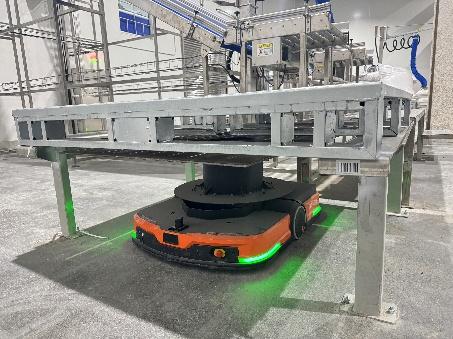
A truly AGV-ready pallet isn’t just about standardized dimensions—it’s about predictability. Automated guided vehicles rely on consistent interfaces, so even minor warping, splinters, or protruding fasteners can cause misalignment or sensor confusion. The pallet must sit dead flat, with perfectly square corners and no surprises underneath that might snag on a lift mechanism.
Material choice plays a bigger role than most realize. Plastic pallets often outperform wood here because they don’t absorb moisture, swell, or shed debris that can foul guidance sensors. They also hold their shape after repeated cycles, which means the AGV’s taught-in pickup points stay accurate shift after shift.
Smart features separate the truly AGV-ready from the merely compatible. Embedded RFID tags let the vehicle confirm it grabbed the right load, while high-contrast docking targets simplify vision-based alignment. Bottom openings need careful engineering too—they must match the AGV’s fork spacing precisely, with enough clearance to avoid scraping when the suspension adjusts on uneven floors.
Decoding Supplier Claims: Beyond the Standard Spec Sheet
Supplier spec sheets often read like polished marketing brochures, carefully curated to highlight strengths while burying limitations in fine print or technical jargon. The real story usually lies in what's omitted—things like performance degradation under sustained load, material fatigue points, or compatibility quirks that only surface in real-world integration. Relying solely on these documents is like judging a car by its brochure photos without ever opening the hood.
Getting past the glossy claims means stress-testing components under conditions that mimic actual usage, not just the ideal lab benchmarks suppliers love to quote. For instance, a power supply rated at 500W might hold that output at 25°C but throttle severely at 45°C—exactly the temperature it would face inside a tightly sealed enclosure. Cross-referencing independent teardowns, field failure rates, and even reaching out to engineers who've deployed the part in similar applications often reveals patterns no datasheet will volunteer.
It’s also critical to decode the context behind certifications and tolerance figures. A ±1% tolerance might sound precise until you realize it applies only within a narrow frequency band or fresh off the production line, drifting further with age. Similarly, “compliant” can mean the component passed a one-time audit rather than ongoing conformance. The savviest design teams build their own verification frameworks, treating supplier claims as hypotheses to be challenged rather than facts to be trusted.
Tailoring Your Pallet Design Without Derailing Automation
Customizing pallets to fit unique product shapes or workflows often feels like walking a tightrope—lean too far toward bespoke design and you risk jamming conveyors or confusing robotic pickers. The trick lies in embedding customization within the boundaries of automation’s unspoken rules, such as maintaining uniform outer dimensions and consistent load faces. Tweaks like adding specialized inserts or adjustable dividers can accommodate odd-sized items without altering the pallet’s overall footprint, letting the automation systems read it as just another standard unit. This approach lets you address specific packaging needs while keeping the automated line humming along as if nothing ever changed.
Material choice is another silent negotiation between customization and machine compatibility. A pallet that’s gentle on delicate products might use a composite surface with a higher friction coefficient, but that same texture can cause erratic behavior on roller conveyors if not properly tested. The trick is to zone the customization: apply grip-enhancing layers only where the product makes contact, while leaving the load-transfer edges smooth and predictable. Even subtle alterations like embedded RFID slots or snap-on corner protectors can boost traceability or reduce damage without introducing irregular geometries that sensors would misread. When done right, these modifications become invisible to the automation, yet indispensable to the operation.
Real-world success often comes from iterative prototyping with the people who live on the floor. Designers who spend time watching how a customized pallet sails—or stumbles—through a high-speed sorter can catch friction points that CAD models miss. A slight recess for a bolt head or a beveled entry edge can mean the difference between a pallet that glides into place and one that causes a cascade of stoppages. The goal isn’t to force automation to adapt; it’s to weave the custom features into a design that the machines already accept as trustworthy. This collaborative tweaking process turns pallet design from a potential disruption into a quiet enabler of both efficiency and product protection.
From Pilot to Scale: Smoothing the Transition with the Right Partner
A pilot project often generates excitement and proof of concept, but moving from that controlled test to a full-scale rollout introduces a host of new variables. Operations that worked smoothly on a small scale can buckle under increased demand, and the internal team may lack the bandwidth or specialized knowledge to handle the growth. A partner who has guided numerous companies through this exact phase brings practical insight, helping to anticipate bottlenecks and design a rollout that matches your organization’s tempo without overwhelming your resources.
The transition hinges on more than just adding servers or hiring more staff. It involves refining processes, strengthening support structures, and often rethinking the user experience to handle a broader audience. A skilled partner acts as an extension of your team, filling skill gaps in areas like infrastructure scaling, data migration, and change management. They adapt their approach based on real feedback loops, ensuring that the expansion feels organic rather than forced, and that the core value of the initial pilot isn’t diluted when deployed at enterprise level.
Ultimately, the right partner keeps the momentum going without letting the project lose its soul. They help navigate organizational resistance, align stakeholders through clear communication, and instill confidence by demonstrating measurable progress. With their support, what started as a compact pilot can evolve into a robust, company-wide capability that delivers consistent outcomes.
Measuring Success Beyond the Initial Price Tag
A tempting low price rarely tells the full story. That budget-friendly option might hide a short lifespan, frequent repairs, or inefficient energy consumption that steadily drains your wallet. Smart buyers look past the sticker number and ask tougher questions about what ownership truly costs over time.
Consider maintenance contracts, replacement parts, and the inevitable downtime when something fails. A slightly more expensive alternative often includes better support and build quality that prevents those hidden headaches. The real measure isn't what you pay today, but what you keep paying year after year.
Shifting focus to total value reveals surprising insights. That higher upfront investment may actually prove cheaper when you account for durability and performance. It’s a mindset that rewards patience and research, steering your decisions away from short-term thrills toward long-term satisfaction.
FAQ
The underside clearance and cross-beam placement. Many assume standard designs work, but AGVs rely on specific fork or roller entry points. Inconsistent spacing can cause jolts during lift-off, wearing down positioning sensors faster than expected.
A supplier without a mock AGV loop can’t replicate real acceleration and deceleration forces. This leads to pallets that slide or tilt during transit, triggering safety stops. Insist on dynamic testing that mimics your actual route patterns.
Lower upfront cost often sacrifices dimensional consistency. Even minor warping under shop temperature shifts can mislead AGV navigation lasers, causing rerouting delays that compound across shifts. Precision-grade materials reduce variability.
Pallets that shed particles from wood or porous plastics contaminate sensitive production lines. A knowledgeable supplier will propose sealed composite surfaces and edge banding, aligning with your cleanroom class without adding excessive weight that strains AGV batteries.
Imbalanced loads force one side of the AGV’s motors to compensate constantly, overheating brushless drives. A pallet designed with modeled weight paths can lower maintenance intervals by up to a third, particularly in multi-shift operations.
Limited understanding of your AGV’s communication protocols. If they can’t discuss how pallet presence sensors or RFID tags integrate with your fleet manager, their pallets may become invisible data points, breaking traceability in automated workflows.
Yes, glossy finishes can create reflections that confuse LiDAR or optical sensors, while dark surfaces may absorb needed IR light for certain guidance systems. A specialist supplier tests reflectance values against your AGV’s specific sensor wavelengths.
Conclusion
Selecting a pallet supplier for OEM AGV systems goes far beyond a simple purchasing decision—it's about safeguarding your entire automated material handling investment. The hidden costs of mismatched pallets, from frequent line stoppages to premature wear on AGV components, can silently erode productivity. A truly AGV-ready pallet isn't just about dimensional accuracy on a spec sheet; it demands consistent flatness, vibration damping, and precise interface geometries that hold up under dynamic loads. Smart buyers learn to decode supplier claims by asking for real-world validation data, not just polished brochures. They look for evidence of impact testing, sensor compatibility trials, and long-term dimensional stability under varying environmental conditions.
Tailoring pallet designs for specific loads or workflows doesn't have to derail broader automation goals if you work with suppliers who understand both the mechanical and digital ecosystem. A partner who can simulate pallet-AGV interactions early and iterate quickly keeps your customization on track. When scaling from pilot to full deployment, the right supplier smooths the transition with local support, inventory agility, and a clear quality feedback loop. Ultimately, measuring success requires looking past the initial price tag toward total lifecycle costs, including maintenance interventions, energy consumption, and operational uptime. A well-chosen pallet supplier becomes a strategic enabler, turning automated vehicles into a seamlessly integrated material flow—not a source of perpetual firefighting.
Contact Us
Contact Person: Johnny
Email: [email protected]
Tel/WhatsApp: +86 18151010686
Website: https://lydstorage.com