
Professional Food Extruder – A Complete Guide to Functions and Applications
2026-05-20
In the fast-paced world of snack production, a professional food extruder is more than just a machine—it's the heart of innovation. From puffed snacks to textured proteins, its versatility fuels endless product possibilities. But not all extruders are built the same. Understanding key functions and real-world applications can mean the difference between average output and market-leading quality. That’s where MINGDE comes in, combining precision engineering with deep industry know-how to help you get extrusion right from day one.
The Science That Powers Every Extrusion Cycle
At the heart of any extrusion line lies a delicate interplay of heat transfer, rheology, and mechanics. The raw material, whether polymer, metal, or food paste, undergoes a dramatic transformation from solid to a precisely flowable state. This shift isn’t merely about reaching a set temperature; it’s a dance of thermal conduction from barrel heaters and shear heating generated by the screw. The material’s viscosity must drop enough to be pushed through the die, yet remain stable enough to hold its shape immediately after exiting. Misjudge this balance, and you get degradation, surging, or dimensional inaccuracy.
Rheology—the science of how materials deform and flow—becomes the silent architect of every successful cycle. Different formulations exhibit distinct behaviors under stress: some thin out dramatically when sheared, while others resist flow until a critical yield point is surpassed. The screw design leverages this knowledge, gradually compressing and mixing the material to homogenize temperature and consistency. A well-understood rheological profile allows engineers to predict pressure drops across the die and optimize throughput without compromising melt quality or introducing defects like melt fracture.
Modern extrusion isn’t just empirical; it’s governed by real-time analytics that turn raw data into actionable insight. Sensors track melt temperature, pressure, and even spectroscopic composition mid-process, feeding control loops that adjust heater zones, screw speed, or feed rate instantaneously. This closed-loop intelligence replicates the intuitive feel of a seasoned operator, but with sub-millisecond precision. The result is a process that self-corrects against raw material variations and ambient shifts, ensuring each cycle delivers parts with tight tolerances and consistent mechanical properties—all rooted in the fundamental physics of flow and phase change.
Standout Capabilities of Professional Food Extruders
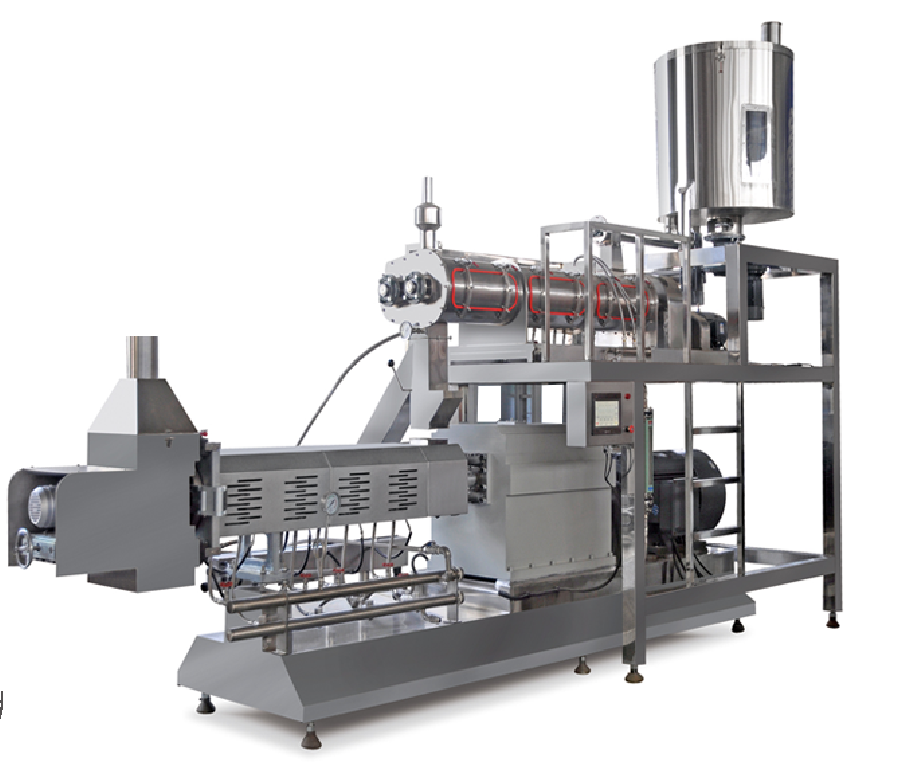
Professional food extruders operate at a level of precision that transforms raw ingredients into consistently shaped and textured products, from dense protein snacks to airy breakfast cereals. The machine’s ability to apply intense shear, heat, and pressure within a continuous barrel allows for real-time adjustments to expansion, density, and crispiness—something batch processing can never match.
One often overlooked capability is the sheer adaptability built into modern extrusion lines. By swapping out screw configurations, die plates, or barrel segments, a single extruder can pivot between producing textured vegetable proteins, fortified rice, or even high-moisture meat analogues without major downtime. That modularity is what makes it a backbone for R&D-driven kitchens and scalable production alike.
Beyond shaping and cooking, these systems integrate hydration, mixing, and even sterilization in a single pass—dramatically cutting down on water and energy use per kilogram of finished product. The result is not just efficiency but a cleaner process where clean-label demands are met by reducing the need for downstream additives or conditioning steps.
From Snacks to Pet Food: Real-World Applications
The journey of snack manufacturing techniques into the pet food aisle might seem unexpected, but it makes perfect sense when you consider the shared priorities. Both industries rely heavily on extrusion, drying, and flavor encapsulation to create products that are shelf-stable, palatable, and nutritionally consistent. What started as a way to produce crunchy cheese puffs and savory crackers has quietly evolved into the backbone of modern kibble and treat production. The same twin-screw extruders that shape breakfast cereals now churn out dental chews and high-protein training rewards, often running on similar lines with only minor adjustments to temperature and moisture profiles.
Real-world examples of this crossover are everywhere once you know where to look. A co-manufacturer in the Midwest, originally known for its puffed rice cakes, now dedicates half its capacity to air-dried dog food toppers. Another facility that pioneered low-temperature dehydration for fruit leathers has pivoted to making single-ingredient jerky treats for pets, using the same gentle process to preserve nutrients without artificial additives. Even the surge of insect-based pet proteins borrows directly from snack bars’ earlier experiments with cricket flour and mealworm powder. The equipment, the food safety protocols, and even the sensory testing panels often require little more than a change of uniforms.
What drives this migration isn’t just shared machinery—it’s a fundamental shift in how owners view their pets. As people demand cleaner labels and ingredient transparency for themselves, they extend those expectations to their dogs and cats. A snack company that has already invested in non-GMO supply chains or organic certifications can carry that credibility into pet food with surprising ease. That’s why you’ll find a popular jerky brand selling identical-looking strips for humans and canines, differentiated mainly by packaging and a slightly lower sodium content. In a world where the line between “human grade” and “feed grade” keeps blurring, the real-world applications are less about invention and more about clever adaptation.
How to Match Ingredients with Extruder Settings
Matching ingredients to extruder settings starts with understanding how each component behaves under heat and pressure. Starches, proteins, and fibers all react differently inside the barrel, so it's essential to consider their moisture content, particle size, and thermal sensitivity. For instance, high-starch blends typically require moderate temperatures and sufficient water to ensure proper gelatinization without scorching. On the other hand, protein-rich recipes often demand lower shear and careful temperature control to avoid denaturing and off-flavors. Fine-tuning the screw configuration and barrel temperature zones to the specific ingredient mix can drastically improve texture and consistency.
When working with fibrous ingredients or whole grains, you might need to increase the screw speed or adjust the die geometry to maintain a smooth flow and prevent blockages. Fiber tends to absorb more moisture, so balancing water content becomes crucial. A gradual increase in temperature along the barrel can help in breaking down tough structures without over-expansion. Testing small batches and recording the settings for each ingredient combination will save time and material in the long run. Pay attention to how the dough behaves at the outlet—dry and crumbly strands suggest insufficient water or low shear, while sticky, glossy ribbons often mean excess moisture or overheating.
Finally, don't overlook the role of additives like oils, lecithin, or emulsifiers, which can dramatically change the melt viscosity. Even small amounts can affect how the material flows through the extruder and expands upon exiting. Adjust the feeder rate and barrel temperature accordingly to compensate for these lubrication effects. Remember that external factors such as ambient humidity can also shift the ideal settings, so be prepared to tweak parameters throughout the production run. Developing a deep familiarity with both your ingredients and equipment allows you to quickly dial in the right configuration for any new recipe, reducing downtime and waste.
Practical Steps to Elevate Product Quality
Start by embedding quality into your team's daily rhythm. Replace abstract goals with specific, measurable checkpoints that align directly with user needs. When every team member, from developers to designers, routinely asks "how does this serve the end user?" during standups and reviews, quality stops being an afterthought and becomes a shared reflex. This shift in mindset often brings hidden assumptions to light early, preventing costly fixes down the line.
Build feedback loops that are fast and fearless. Instead of lengthy QA phases at the end, integrate lightweight testing into each iteration—encourage cross-functional pairs to spot edge cases in real time. Give equal weight to internal dogfooding sessions and user beta feedback, but act on insights within days, not weeks. When fixes are rolled out rapidly, the product feels alive and responsive, and your team gains a deeper intuition for what truly matters to users.
Treat documentation and coding standards as living tools, not dusty manuals. Champion a culture where improving the codebase's health is celebrated alongside new features. Small, consistent refactors and clear, up-to-date specs reduce friction for everyone touching the product, making it easier to sustain high quality over time without heroic efforts.
The Next Wave of Extrusion Technology
Extrusion is moving beyond simple shaping—it's becoming a precision-driven, digitally controlled process that adapts in real time. New sensor networks embedded along the barrel and die provide instant feedback on temperature, pressure, and melt uniformity, allowing machines to auto-correct variations before they become defects. This shift toward closed-loop intelligence is quietly redefining what's possible in tight-tolerance profiles.
Materials innovation is pushing the boundaries further. Multi-material co-extrusion now layers functional properties directly into a single pass, combining rigid and flexible zones, conductive paths, or barrier layers without secondary assembly. Meanwhile, bio-based and recycled feedstocks are finally meeting performance benchmarks, driven by screw designs that handle unpredictable viscosities with surprising stability.
Perhaps most telling is the move toward modular, service-oriented machinery. Manufacturers are offering extrusion lines that can be reconfigured within hours—not days—for different products, reducing downtime and inventory reliance. Combined with predictive maintenance algorithms that learn from each run, the next wave isn't just about faster or cheaper; it's about making extrusion an agile, responsive part of a smarter factory floor.
FAQ
A professional food extruder is a heavy-duty industrial machine designed to mix, cook, and shape food ingredients under controlled heat and pressure. Unlike home kitchen extruders that simply push soft doughs through a die, industrial versions can handle high throughput, precise temperature control, and complex processes like starch gelatinization, protein texturization, and continuous cooking. They're built for durability, hygienic design, and reproducibility, making them essential for large-scale production of products like breakfast cereals, pasta, snacks, and pet food.
Twin-screw extruders offer superior mixing, more uniform heat transfer, and better control over shear because the intermeshing screws continuously knead and convey the material. This results in consistent product texture, even cooking of heat-sensitive ingredients, and the ability to handle a wider range of moisture levels and fat contents. They also allow precise control of residence time distribution, so every particle gets similar treatment, which is critical for high-value items like meat analogues or fortified baby cereals.
Key parameters include screw speed, barrel temperature profile, feed rate, moisture content, and die pressure. Screw speed dictates mechanical shear and residence time, directly influencing starch breakdown and expansion. Temperature profiles control cooking intensity and Maillard reactions. Moisture acts as a plasticizer, affecting viscosity and expansion. Feed rate must be balanced with screw speed to avoid surging. Die pressure impacts product density and shape definition. Adjusting these allows operators to fine-tune crispiness, density, solubility, and appearance without changing the basic recipe.
High-moisture extrusion is the go-to method for plant-based meats. Using a twin-screw extruder with a long cooling die, protein-rich flours or concentrates (soy, pea, wheat) are mixed with water, heated to denature proteins, and forced through a die where slow cooling aligns the proteins into fibrous structures that mimic animal muscle. The result is a chewy, striated product that can be cut into chunks or strips. Fine-tuning the specific mechanical energy input and cooling rate is the secret to creating realistic mouthfeel without synthetic binders.
Critical safety features include rupture discs or pressure relief devices on the barrel to prevent catastrophic failure from over-pressurization, guarded interlocks on access panels to stop operation during cleaning, temperature limit controllers to avoid thermal runaway, and emergency stop buttons on multiple sides. Because extruders operate at high temperatures and pressures, a sudden blockage can cause violent discharge. Proper safeguarding not only protects operators from steam burns and hot equipment but also ensures the machine doesn't damage itself during a process upset.
Selecting a screw profile is like picking the right set of gears for a custom engine. It's a balance of conveying elements, kneading blocks, and reverse-flight sections. Longer kneading zones increase shear for gelatinization and mixing but raise temperature and residence time. Reverse elements create backpressure and improve melting. You start with a basic profile based on the ingredient's viscosity profile and desired cook level, then iterate through pilot trials. For example, high-starch products need intense shear early on, while heat-sensitive vitamins require gentler handling near the end. All major manufacturers provide modular screw systems so you can swap out individual elements without replacing the entire shaft.
Preconditioning is a separate step where dry ingredients are steam-injected and mixed with water before entering the extruder. It hydrates particles, initiates starch swelling, and preheats the mass evenly. Skipping or under-preconditioning can lead to uneven cooking, lower throughput, higher energy consumption in the barrel, and final products with raw spots or inconsistent expansion. For delicate products like infant foods, proper preconditioning also reduces mechanical shear later, which helps preserve heat-sensitive nutrients and flavors.
Consistent maintenance revolves around monitoring wear items like screws, barrels, and die plates. Regular inspection of melt thermocouples and pressure transducers ensures accurate readings because drift can lead to poor process control. Lubricating thrust bearing assemblies per schedule prevents costly failures. After every run, proper shutdown sequences with purge materials are crucial to avoid baked-on residues. Establish a vibration monitoring baseline to catch bearing wear early. Finally, annual alignment checks of the screw shafts to the gearbox output shafts prevent premature spline wear, which is often overlooked until it causes a major breakdown.
Conclusion
Professional food extruders blend precise mechanical force, thermal energy, and ingredient science to reshape raw materials into endless snack, cereal, and pet food varieties. The extrusion cycle relies on a delicate balance of screw speed, barrel temperature, and moisture content, which together transform starches and proteins under high pressure. When the mixture exits the die, the sudden pressure drop causes expansion, locking in texture and shape. This interplay of parameters means that even slight adjustments can dramatically alter density, crispness, and mouthfeel. Modern extruders stand out for their modular screw configurations, quick-change die systems, and real-time process controls that allow one machine to produce everything from puffed corn curls to dense protein bars. A growing trend is co-extrusion, where a soft filling is injected into a crunchy shell in a single pass, adding layers of flavor and sophistication without secondary operations.
The versatility reaches far beyond the snack aisle. Manufacturers now shift seamlessly between breakfast cereals, texturized vegetable proteins, aquatic feed, and semi-moist pet treats by swapping tooling and tweaking recipes. Success depends on matching the ingredient profile—starch type, protein level, fat content—to the right screw geometry and thermal profile. For example, high-amylose starches demand longer residence times and higher temperatures for optimal gelatinization, while heat-sensitive vitamins require cool barrel zones and post-extrusion coating. Practical steps like preconditioning with steam, fine-tuning cutter speed, and uniform feeding dramatically lift product consistency and reduce waste. Looking ahead, innovations such as in-line rheometry sensors, energy-efficient servo drives, and fully automated recipe management are redefining what extruders can do. These advances shrink changeover times, slash energy use, and open the door to custom textures and high-protein formulations, cementing the extruder’s role as the heartbeat of modern food manufacturing.
Contact Us
Contact Person: LILY SUN
Email: [email protected]
Tel/WhatsApp: 0086-13969103791
Website: https://www.snackfoodmachinery.com/