
Water Chiller Supplier Guide to Choosing the Right Industrial Chiller
2026-10-22
Selecting an industrial chiller isn't just about matching tonnage—it's about aligning cooling capacity, energy use, and long-term reliability with your specific process demands. Yet with countless suppliers offering near-identical spec sheets, how do you tell meaningful engineering from marketing fluff? This guide cuts through the noise, walking you through load calculations, condenser types, part-load efficiency, and maintenance realities. Along the way, we reference practical insights from Worldbase, a supplier known for straightforward chiller solutions rather than one-size-fits-all claims. If you're tired of guesswork and want to make a decision your operations team will thank you for, read on.
Sizing Without the Guesswork: Matching Chiller Capacity to Your Heat Load
Matching a chiller to a heat load starts with rejecting the habit of using nameplate capacities as your baseline. Those figures are often based on ideal operating conditions that rarely exist in the field. Instead, pull real process data: flow rates, temperature differentials, and duty cycles. Separate the peak load from the sustained load—many systems spend less than five percent of their runtime at maximum demand, so sizing for the worst-case scenario can leave you with a compressor that short-cycles and a power bill that hurts.
A common error is layering safety factor on top of safety factor. You add ten percent for future expansion, another fifteen for fouling, and before you know it the chiller is fifty percent oversized. That oversized unit will not simply run at part load efficiently; it will hunt, cycle excessively, and fail to dehumidify or control temperature tightly. Instead, quantify the actual heat load by measuring power input to the process, heat exchanger performance, or even using a temporary portable chiller to benchmark the real thermal demand before committing to a permanent unit.
Finally, treat heat load as a moving target. Ambient air temperature, cooling water temperature, production schedules, and even seasonal humidity shifts all influence the load. A chiller sized for winter operation might be inadequate in July. Rather than guessing, install temporary flow and temperature sensors for a few weeks to capture the full operating envelope. This data gives you a realistic load profile that allows you to select a chiller with the right balance of capacity and turndown—so the unit runs steadily, not nervously, across the entire range.
Air-Cooled or Water-Cooled? A Practical Look at What Actually Fits Your Facility
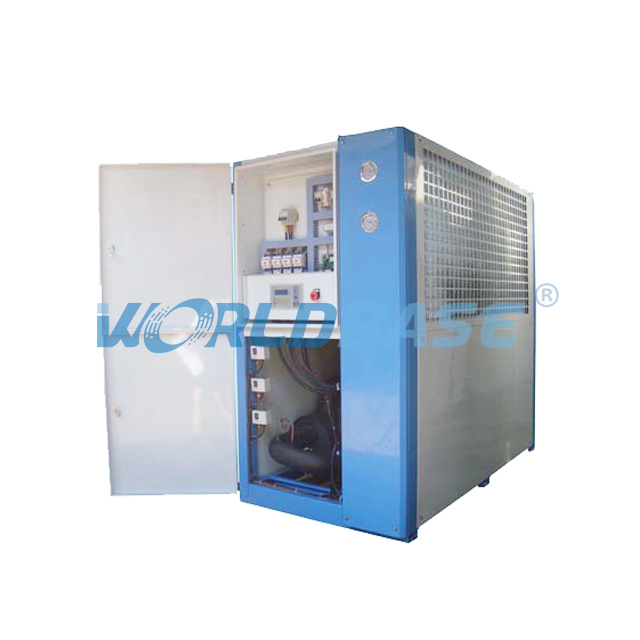
Choosing between air-cooled and water-cooled systems often starts with a simple question: where is the heat actually going? Air-cooled units push heat directly into the surrounding room or outdoor air, which makes them straightforward to install and relatively forgiving when space is tight. They work well in smaller facilities, server rooms, or areas where running water lines would be impractical or too costly. The trade-off is that they can make the immediate environment warmer and noisier, and their efficiency drops noticeably when ambient temperatures climb.
Water-cooled systems, by contrast, move heat into a water loop that carries it away to a cooling tower, dry cooler, or building chilled-water system. That means the heat leaves the room entirely, which is a major advantage in high-density environments or when you need precise temperature control without dumping extra heat into the same space. But the upfront complexity is real: you need access to a reliable water source, proper drainage, and often a dedicated mechanical room. Maintenance is also more involved—water treatment, leak checks, and pump upkeep are all part of the deal.
The practical answer usually comes down to what your building already has. If you’re retrofitting an older space with no existing water infrastructure, an air-cooled unit will almost always be the faster, cheaper path. If you’re building new or expanding a facility that already has a chilled-water loop, water-cooled equipment can give you better long-term efficiency and a cleaner thermal profile. Start by checking your available utilities, your heat load, and how much noise and ambient heat your staff can tolerate—then pick the option that doesn’t fight the building you’re actually in.
Beyond the Purchase Price: Why Total Cost of Ownership Deserves a Second Look
Many buyers fixate on the sticker price, but that number rarely tells the whole story. A low upfront cost can quietly hide higher energy bills, frequent repairs, or expensive replacement parts that surface months later. By looking at the full lifespan of an item—from installation and maintenance to disposal—you start to see which option actually costs less over time.
This shift matters most for durable goods like vehicles, appliances, and industrial equipment. For example, a cheaper machine might need servicing twice as often and consume more power each cycle, erasing any initial savings within a year. Taking a longer view helps you avoid the trap of buying something twice: once when you think you're saving money, and again when the real costs add up.
EER, COP, and All That: Decoding Efficiency Numbers Without the Jargon Overload
Air conditioners and heat pumps often come with energy ratings that look more like alphabet soup than useful information. Two acronyms keep popping up: EER and COP. In plain terms, EER tells you how efficiently a unit cools when it's blazing hot outside, while COP measures heating efficiency under mild conditions. The core question both answer is simple: how much useful heating or cooling do you get for each unit of electricity you pay for? Once you see past the initials, the numbers start to make practical sense.
Here's the trick that most guides skip: the higher the number, the less energy you're wasting. EER is calculated at a fixed outdoor temperature of 95°F, so it's a good benchmark for summer heat. COP, on the other hand, varies with outdoor conditions because heat pumps work harder when it's colder. Instead of memorizing formulas, think of EER as the highway fuel economy rating on a car window sticker, and COP as a flexible number that changes with the season. If a unit shows EER of 12 and COP of 3.5 at 47°F, it simply means the cooling mode is decent and the heating mode is roughly three and a half times better than using electric resistance heat.
A common mistake is comparing EER directly to COP. They use different test conditions and different units, so a side-by-side number comparison can mislead you. What matters is comparing the same metric between different models: EER to EER, or COP to COP at the same outdoor temperature. Also, don't ignore the small print on the EnergyGuide label. Real-world performance depends on your local climate, how well your home is sealed, and whether the system is sized correctly. If you live in a place with mild winters and scorching summers, EER deserves more attention. In a colder region, look closely at COP at low temperatures. Breaking down these numbers this way turns a confusing spec sheet into a useful shopping tool.
Supplier Red Flags and Green Lights: What to Ask Before You Commit
Before you sign anything, watch how a supplier handles your questions. If they dodge requests for references or give you a lead time that changes every time you ask, that's a red flag. Another one: when the price feels too good to be true and the salesperson can't explain the cost breakdown. Vague answers about material sourcing or quality checks usually mean you'll be dealing with surprises later. Real suppliers don't mind you poking around.
On the flip side, a green light is a supplier who sends you their latest third-party audit report without being asked. They'll walk you through their production schedule, show you how they measure defects, and introduce you to the actual person who'll handle your account. If they proactively offer a small trial order or invite you to visit the factory, that's even better. These are signs they've done this before and aren't afraid of scrutiny.
Before you commit, ask a few pointed questions: What happens when a shipment fails inspection? Who pays for the rework and the delay? Can you see the QC checklist for the last three orders? How do they handle raw material shortages mid-production? And don't forget the boring stuff: Who owns the tooling if you part ways? What are the payment milestones tied to? If they can answer all of that without getting defensive, you're probably in decent shape.
Future-Proofing Your Cooling: Smart Controls, Refrigerants, and Modular Growth
Cooling infrastructure rarely gets a second thought until it starts limiting what a building or data center can do. The shift toward connected controls changes that. Instead of running on fixed setpoints, systems now read load patterns, occupancy, and even weather forecasts to trim compressor hours without sacrificing comfort. It is less about adding another dashboard and more about letting the equipment respond before someone notices a problem.
Refrigerant choices are getting tighter as regulations and supply pressures push older blends out of reach. Moving to lower-GWP options is not a simple drop-in swap; it means rethinking pipe sizing, leak detection, and service routines. At the same time, modular design gives facilities a way to add capacity in smaller steps rather than betting on one oversized chiller. That combination keeps the door open for growth without forcing a complete rebuild every few years.
FAQ
Start by calculating the heat load from your equipment—usually in BTUs or kilowatts—then add a buffer of about 20% for fluctuations and future expansion. Oversizing wastes energy and causes short cycling, while undersizing leads to constant overheating and premature wear. If you don't have exact specs, ask your equipment manufacturer for heat rejection data rather than guessing based on motor horsepower alone.
Look for someone who asks about your ambient temperature, water quality, flow rate, and space constraints before quoting a price. A solid supplier will offer a site survey or at least a detailed questionnaire, and they should be able to explain why a scroll compressor beats a reciprocating one for your noise-sensitive area, or why a stainless steel evaporator matters if you're running corrosive coolant. If they can't justify their recommendation beyond 'this is our most popular model,' keep looking.
Air-cooled condensers are simpler and fine for most indoor or well-ventilated spaces, but they dump heat into the room—so if your facility already struggles with climate control, you're just moving the problem around. Water-cooled units are more efficient and quieter, but they need a cooling tower or city water supply, plus extra maintenance for scaling and biological growth. Choose based on where the heat goes, not just upfront cost.
Clean condenser fins monthly if you're in a dusty environment—more often if you run 24/7. Check refrigerant pressures and superheat quarterly, not just when something fails. Flush the water side every six months to remove scale and sludge, and replace filters before they look dirty. The best suppliers provide a maintenance log with target values, not just a checkbox sheet. Skipping these steps shortens compressor life by years, even if the chiller 'seems fine.'
Don't rely on the marketing EER or COP at full load, because chillers rarely run there. Ask for IPLV or NPLV ratings, which measure part-load performance—that's where you'll spend 90% of your operating hours. Also check the compressor type: variable-speed or digital scroll compressors save a lot when your load fluctuates. A slightly higher upfront cost for a better part-load rating often pays back in under two years if you run more than 2,000 hours annually.
Beyond the chiller itself, you need to budget for electrical disconnect and wiring upgrades, chilled water piping with proper insulation, a buffer tank if your loop volume is small, and sometimes a water treatment system to prevent corrosion. Air-cooled units need enough clearance for airflow—putting one in a closet is a recipe for high head pressure. Ask for a complete installed cost estimate, including crane or forklift access, before signing anything.
Custom builds are worth it when you have an odd voltage or frequency requirement, need to fit through a narrow doorway, run at extreme ambient temperatures like a desert roof or a freezer room, or your process requires very tight temperature control within half a degree. If your application is standard—say, cooling a CNC spindle or a small laser—a stock unit with the right options will save you four to eight weeks of lead time and 15-30% in cost.
Call their service line on a Friday afternoon and see if a human answers or if you get a voicemail that might take days. Ask for references from customers who bought the same model at least three years ago—then ask those references how quickly they got parts when the compressor failed. Check if the supplier stocks critical spares in your region or if everything ships from overseas with a two-week lead time. A chiller that's down for a month costs far more than any upfront savings.
Conclusion
Choosing an industrial water chiller is rarely about picking the biggest unit or the one with the lowest upfront price. A supplier who knows their craft will start by matching capacity to your actual heat load, factoring in ambient conditions, process variations, and future expansion instead of relying on rough rules of thumb. Then comes the honest air-cooled versus water-cooled debate—not just which one is cheaper to install, but which one fits your facility's water availability, noise limits, and long-term utility costs. That discussion naturally folds into total cost of ownership, where energy consumption, routine maintenance, and component lifespan often dwarf the initial purchase price. If a vendor avoids these numbers or only talks about full-load performance, treat that as a warning sign rather than a sales pitch.
Efficiency ratings like EER and COP can be useful, but only when you see them across the operating range your process actually runs at—partial load matters more than a single ideal point. Ask about real-world service response, spare parts availability, and how the supplier handles warranty claims after the ink dries. Red flags include vague answers about refrigerant phase-outs, proprietary controls that lock you into one service provider, or a modular design that cannot grow with your load. The right chiller supplier will make these technical choices feel less like a gamble and more like a straightforward engineering decision, leaving you with a system that stays relevant for the next decade rather than one that needs replacing in three years.
Contact Us
Contact Person: Mr Yang
Email: [email protected]
Tel/WhatsApp: +8613809083091
Website: https://en.worldbase.cn